Our story
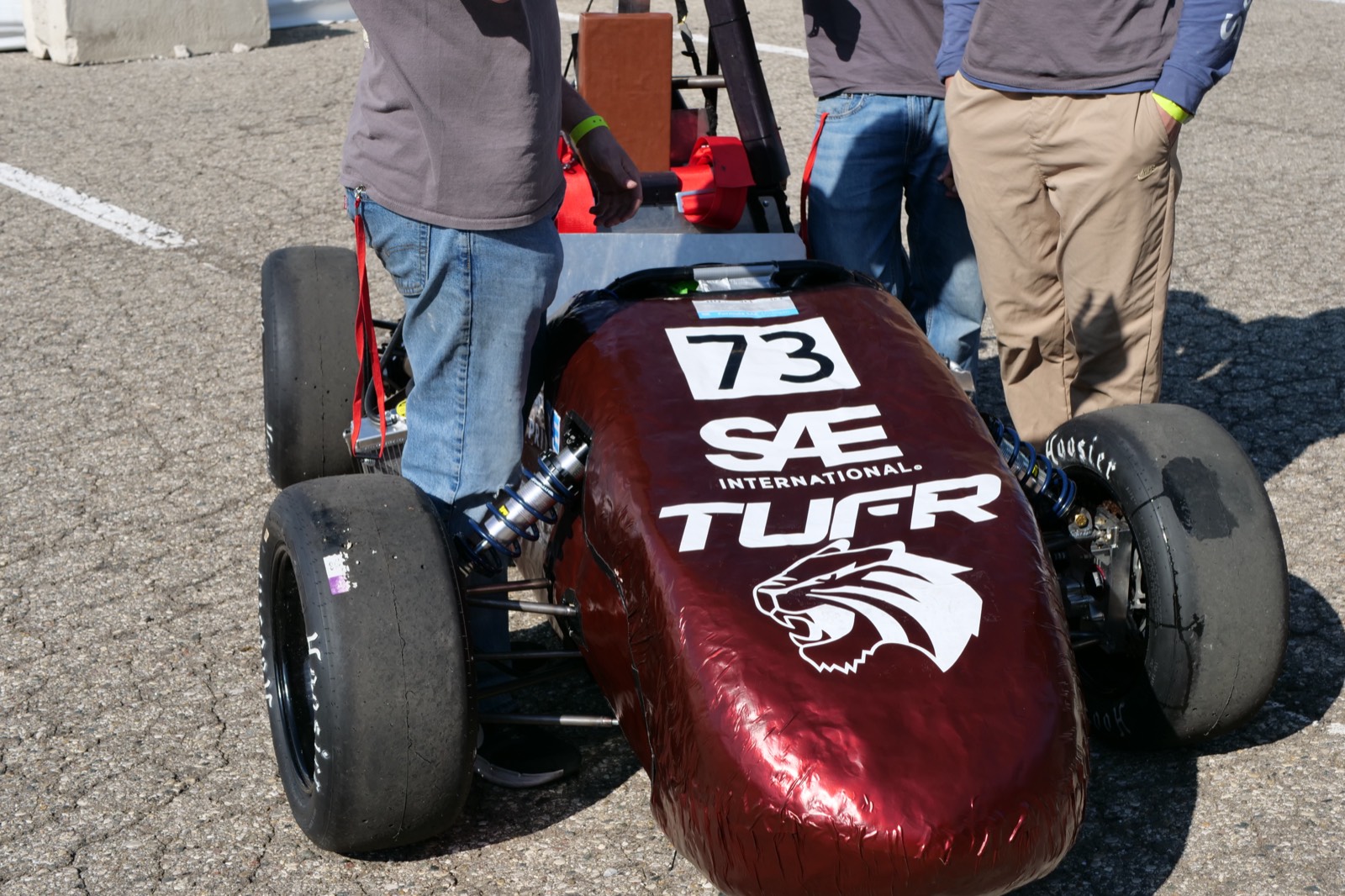
Trinity University Formula Racing is a student-run team that designs, builds, and races a formula-style car. It started from a legacy vehicle and students who shared a dream to race.
The competition

Formula SAE is a student engineering competition run by SAE International. Every year, university teams design, build, and race a small open-wheel car, the kind a weekend autocross racer might drive. More than 100 teams compete at FSAE Michigan alone.
Teams are judged on far more than speed. At competition, the car is scored in static events (engineering design, cost analysis, and a business presentation) and dynamic events (acceleration, skidpad, autocross, and endurance). Before any of that, every car must pass technical inspection, including brake and noise tests. The best car on paper still has to survive the track.
The organization
TUFR is Trinity's Formula SAE chapter: a non-profit, student-run engineering organization open to every major and every year. Engineers design the chassis, powertrain, aerodynamics, and electronics. Business students run finances, sponsorships, and outreach, because a race team is also a small company.
No prior experience needed. Most of what our members know about building a race car, they learned by building one.
Why we do it
We develop engineers and build a car worth being proud of.
We believe the best way to learn is to be responsible for a result. We build engineers who can design, manufacture, manage a budget, and work as a team, and we build a car worth being proud of.
Team history
A Formula-style car had lived at Trinity for seven years as a senior design project before three students with no shop set out to turn it into a fully student-led team, rebranded as TUFR in 2023. Their starting point was a legacy snowmobile engine that was around ten years old. They sourced a new engine, rebuilt the electrical system, and took the whole car apart and rebuilt it. Most of the year went into understanding how every system works together, from the engine and electrical system to the drivetrain and chassis. It was a foundational year spent restructuring the organization itself.
The team built and trained a larger roster, tripling its active membership over its first two years while Car 1 took shape. A loose group of friends became a real organization with a leadership structure, a budget, and a growing sponsorship network, all driven by the original three with no outside guidance. The team fit a new powertrain into the legacy chassis and became the first Trinity team to compete at FSAE Michigan. The lasting value was the mentorship and technical feedback from industry professionals, which changed how the team approaches design.
Car 1 did not pass technical inspection at competition, so Car 2 was built from the ground up in just nine months, moving away from legacy parts so every design choice was student-led. Just transporting the car and team was a major hurdle. About twenty students in six engineering sub-teams and a new business team, a bigger sponsorship network, and three advisors helped the team compete again.
The team is building Car 3, redesigning the elements that failed at last competition and leaning on experienced members who have been here since the start. The main goal this year is passing technical inspection.
The process
Set goals from the FSAE rulebook with the intention of iterating and improving on last year's car, then model the chassis, suspension, powertrain, and electronics in CAD.
Run simulations and hand calculations on loads, weight, and lap time, and debate trade-offs before fabrication begins.
Source materials, cut tube, weld the frame, machine parts, wire the harness, and assemble the car in our shop.
Drive it, break it, learn why, fix it. Repeat until it is ready for competition.
Pass technical inspection, drive the car in the dynamic events, and defend our design and budget in front of judges.
Gallery
Looking ahead
Complete the chassis, powertrain, and electronics, and get the car running.
Prepare the car and the team to pass inspection and compete at an FSAE event.
Recruit more members across every major and strengthen each sub-team.
Sponsors provide the parts, tools, and funding that turn a design into a race car.